When ‘Agree to Disagree’ Becomes a Perceived Shield Against Reality
by Kevin Reed
We’ve all been there:
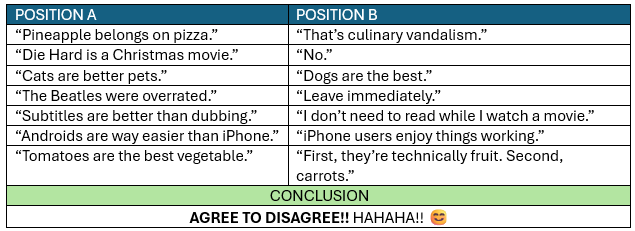
In discussions around preference or opinion, “Agree to disagree” is a healthy recognition that two people have different values or opinions.
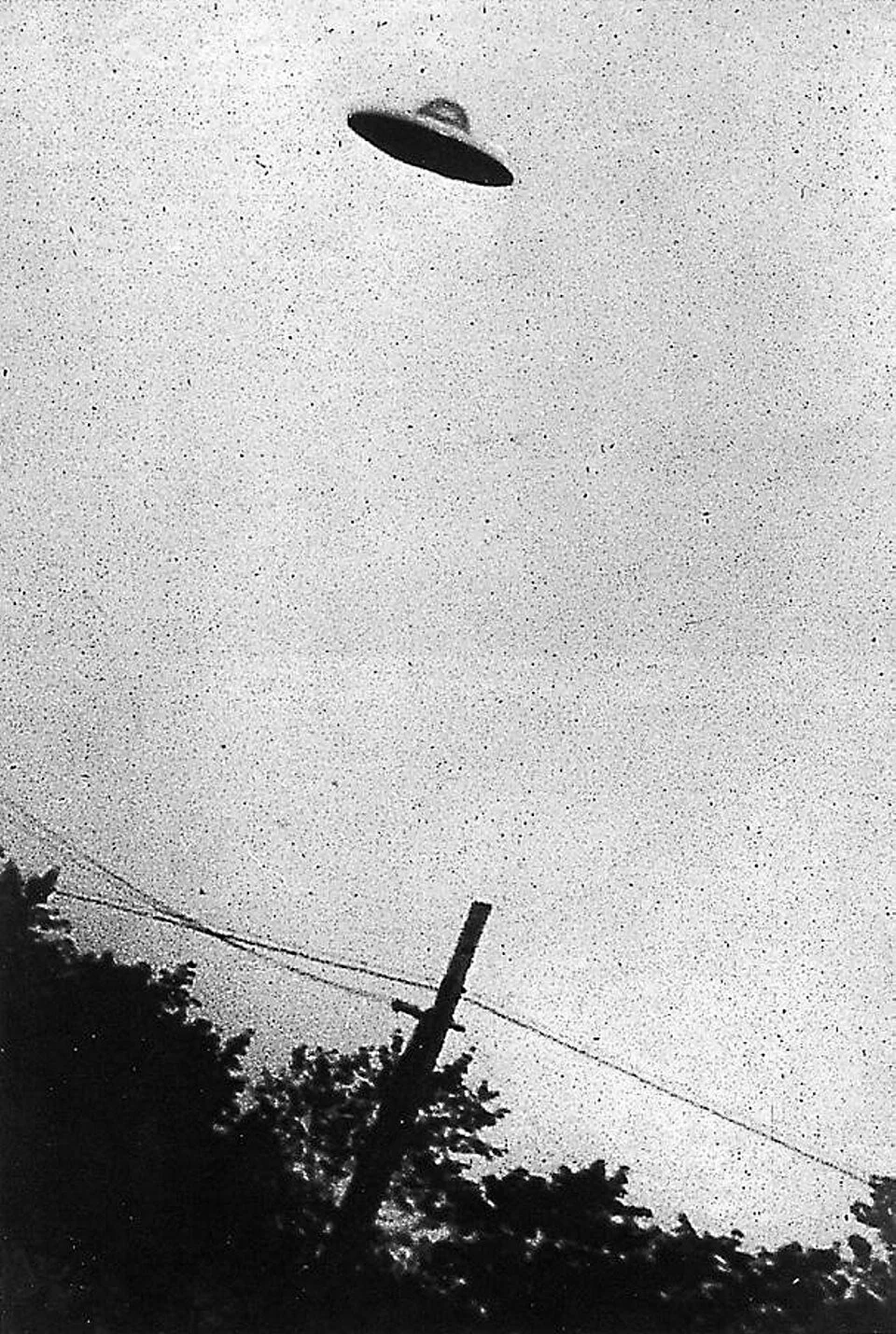
Proof of aliens or of humans throwing things into the air and documenting it with a camera.
Or on things where the evidence is mixed or not yet known.
"Aliens are here and UFOs are aliens."
"Aliens are real but not here."
"Aliens are not real."
Agree to disagree until more is known makes some sense (but there is no evidence of aliens on Earth yet, just sayin’).
In other cases, it might be a conflict-avoidance tactic, and with good reason. You might not be in a safe place to argue something. You might be in a professional environment where your view could impact you negatively. Or maybe you simply don’t have the emotional energy to spend Thanksgiving debating whether Taylor Swift is ruining the NFL with a man wearing wraparound sunglasses indoors while he explains that birds are government drones and chemtrails are making the frogs gay.
Sometimes people say “agree to disagree” because they are overwhelmed by information or the news. They may lack the vocabulary or background to defend their intuition reliably. They may have grown to distrust the sources, or they sense the conversation will never end productively.
Or, sometimes a person’s position highlights a obviously ridiculous position. “The sky is green.”
But there’s another category, because increasingly, “agree to disagree” is being used as a rhetorical escape hatch when someone knowingly cannot defend a claim against evidence. A shield against reality, “if you will,” which might feel good for them, but it doesn’t work in real life. That distinction is critical context in today’s political environments, and modern discourse blurs it all the time.
Some examples:
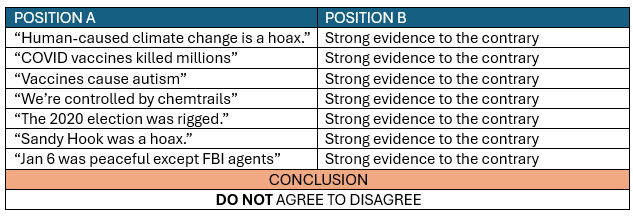
The danger is not disagreement itself. Healthy disagreement (based on evidence) is essential. The danger is treating factual questions as matters of personal preference: “70s music is better than 80s music” is a preference; "Vaccines reduce the risk of many infectious diseases” is a measurable phenomenon.
When a position can no longer withstand the available evidence, discussions often exit through familiar phrases:
“Let’s just agree to disagree”
“Do your own research”
“You just think you’re smarter”
“Stop talking politics”
“You’re a ______ .”
At this point, the conversation may have shifted from evaluating facts to protecting identity. Once a belief becomes tied to tribe, politics, religion, or social belonging, evidence itself can feel threatening. A person changing their mind can threaten their worldview and their standing in their community. So, the person digs in, despite the evidence.
We all do this to varying degrees in our lives. We might have a firm belief around something for years and it might take a long time to figure out that we were wrong and then longer to admit it. It’s human nature. But evidence is what eventually changes your mind.
Patient: “I’m in pretty good shape.”
Doctor: “Your blood pressure, cholesterol, and blood sugar say otherwise”
A few years later, a heart attack and ER trip highlights the actual reality.
So what?
Well, it makes it a heck of a lot harder for us to collectively solve things as a nation or species.
We can’t solve problems if we can’t agree on what reality is based on observable evidence.

Restaurant with crappy service. Looks great. No people.
If your restaurant has bad service, customers stop coming. You can disagree with the reviews, blame the customers, or insist the food is great, but the reality is empty tables, and you lose money and maybe go out of business. Reality is reality, regardless of belief.
Like the struggling restaurant, the realities around climate change, public health, infrastructure, or election-related claims marches on, regardless of belief. Risk mitigation is the only thing humans can do to have an impact, and those are actions that only work then they are based on observable evidence.
When evidence is rejected because it conflicts with identity or ideology, decisions become driven by feelings, emotions, loyalty, and certainty rather than observation, learning, and agreement/disagreement around observable evidence. Resources are wasted, preventable harms increase, and societies lose their ability to adapt to changing conditions.
If we can’t change our mind about something as a society, then we can’t adapt to new things. Not surprisingly, societies that can adapt succeed more than static societies.
None of this means experts are always right. Experts can be wrong. Science can be wrong. Institutions can be wrong. But the answer to outdated or bad evidence is better evidence—not abandoning evidence altogether.
The further our beliefs drift from observable reality, the greater the cost of eventually catching up. If we ever do. It’s kinda like borrowing money. If you pay it back quickly and keep a low balance, it’s okay. If you keep borrowing too much, the interest and balances add up, and you struggle to pay it back or go bankrupt.
Reality charges interest on ignored evidence. The further we fall behind, the harder it is to catch up, the more it costs, and the more dangerous it is. This has cost humans, literally, thousands of years previously (Dark Ages, etc.), and in modern times, decades and centuries, with exponential losses.
The speed of change today is much less forgiving than it was thousands of years ago.
We can do better.