Eclipse Science is the Same Science as Climate Science
By Kevin Reed
This week, millions of people looked toward the sky at a time scientists told them to see the total solar eclipse that took place on August 12, 2026. They traveled to designated locations. They bought eclipse glasses. And at the predicted time, the Moon moved in front of the Sun. And people collectively shared a moment of wonder. A rare gift.
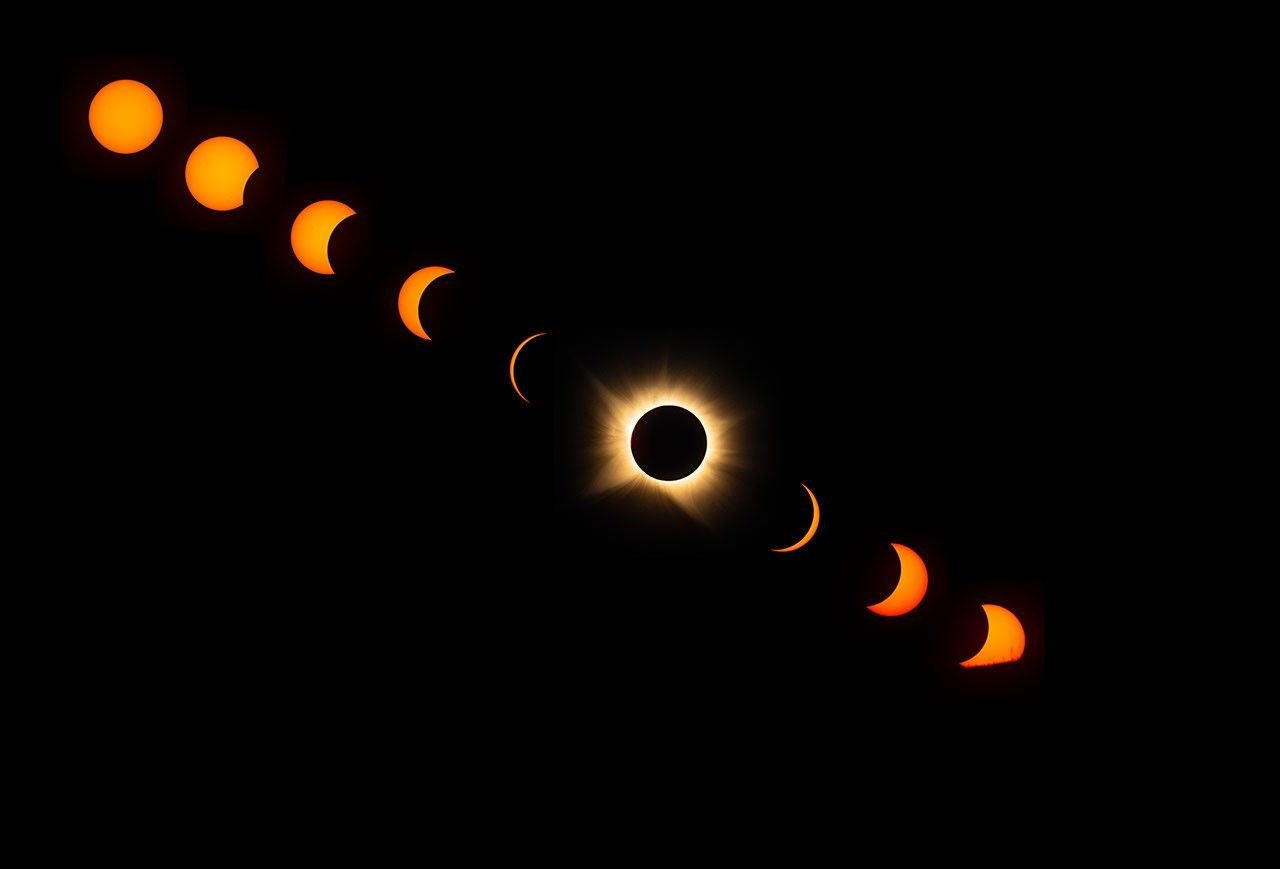
This composite image shows the progression of a total solar eclipse as the Sun sets from San Millán de los Caballeros, Spain, on Wednesday, Aug. 12, 2026. A total solar eclipse swept across parts of Greenland, Iceland, northern Russia, the Atlantic Ocean, Spain, and a small corner of Portugal. A partial eclipse was visible in parts of the U.S., most of Canada, much of Europe, and northwest Africa.
Image Credit: NASA/Bill Ingalls
Nobody stood there and said:
"It's only a theory."
"Scientists have been wrong before."
"That's just a computer model."
"Follow the money."
"Do your own research."
“The eclipse is a hoax!” (Okay someone probably said that somewhere before detailing how the Moon is actually a hologram and Finland doesn’t exist).
We trust the eclipse prediction because science has clearly demonstrated that it can describe the physical world remarkably well.
But here's something worth thinking about:
There isn't one set of science that predicts an eclipse and another set that tells us the planet is warming.
There is one physical universe.
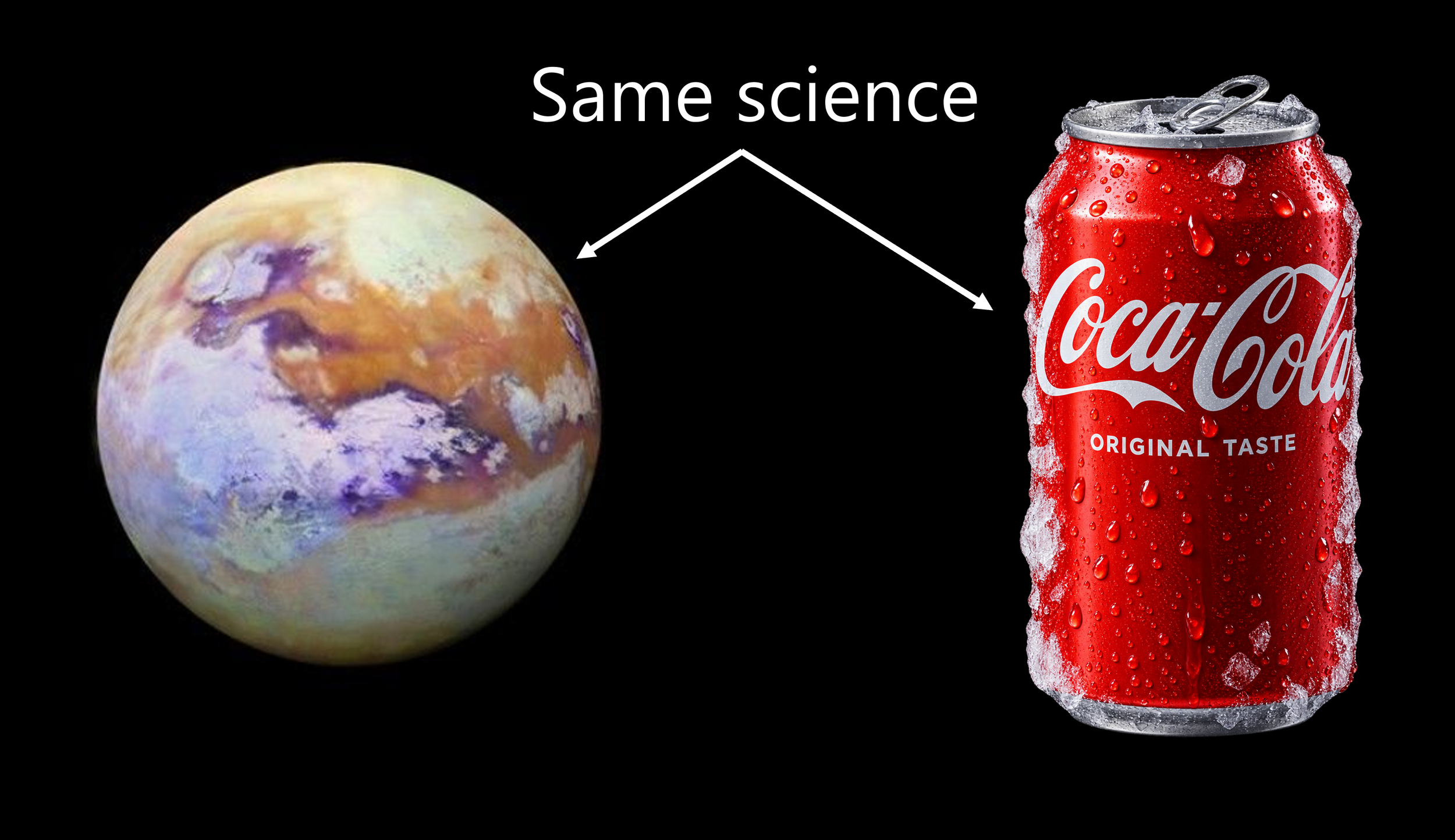
The physics that describes the orbit of the Moon is the same physics used to study Earth’s thermodynamics, radiation, fluid dynamics, gravity, phase changes, heat transfer, gas behavior, optics/electromagnetism, and so on.
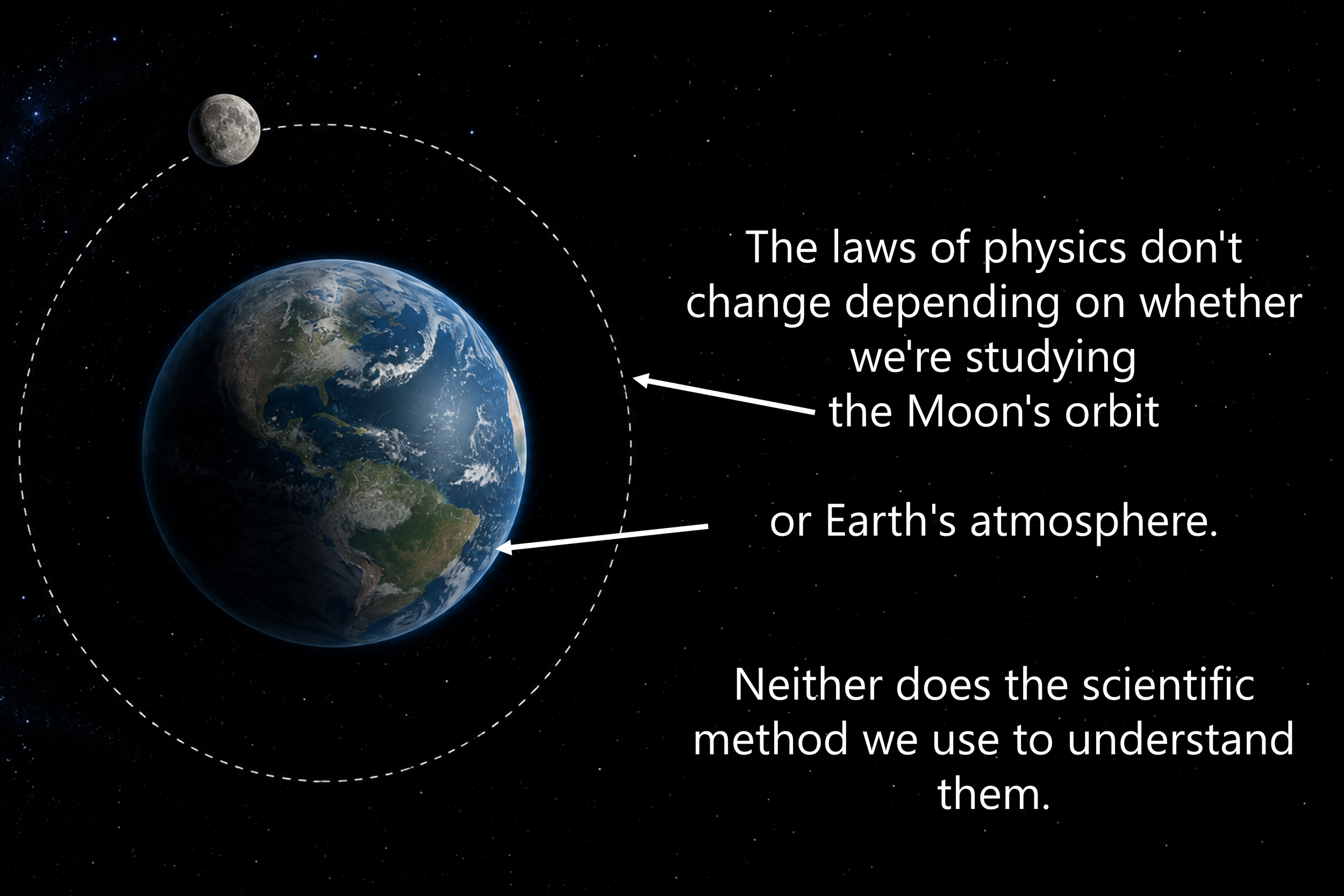
The principles that explain how air moves over a wing are the same principles governing moving gases in an atmosphere.
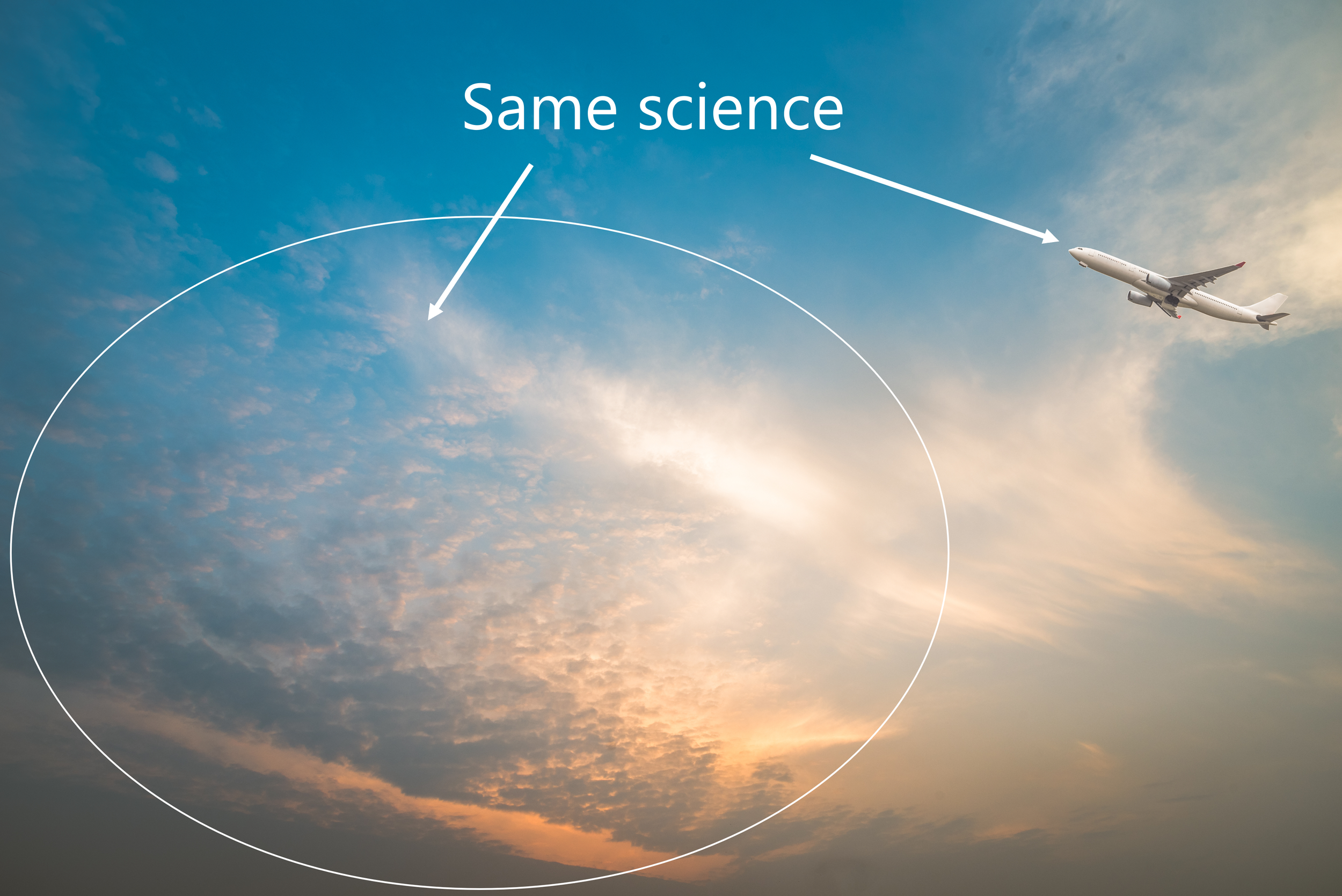
The chemistry happening inside a bottle of Coca-Cola belongs to the same periodic table and follows the same chemical rules scientists use to determine the composition of the atmosphere of Titan, Earth, or Venus.
The electromagnetic radiation that allows us to see the Sun is governed by the same physics that tells us how carbon dioxide interacts with infrared radiation leaving Earth.
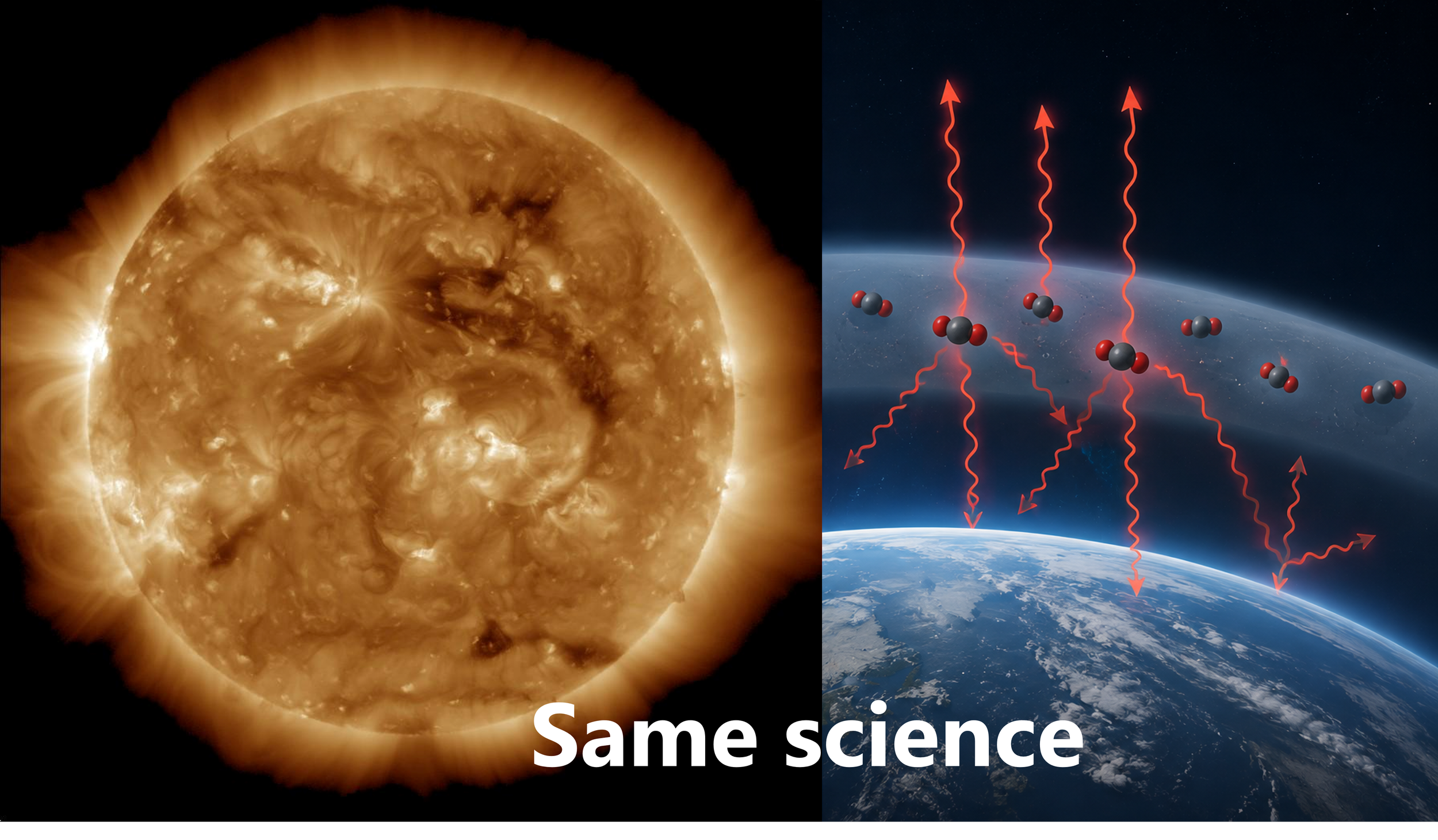
Nature doesn't maintain separate rulebooks for eclipses, airplanes, soft drinks and climate.
Humans have divided knowledge into departments, but the universe didn't. And science is the tool humans use to understand the universe.
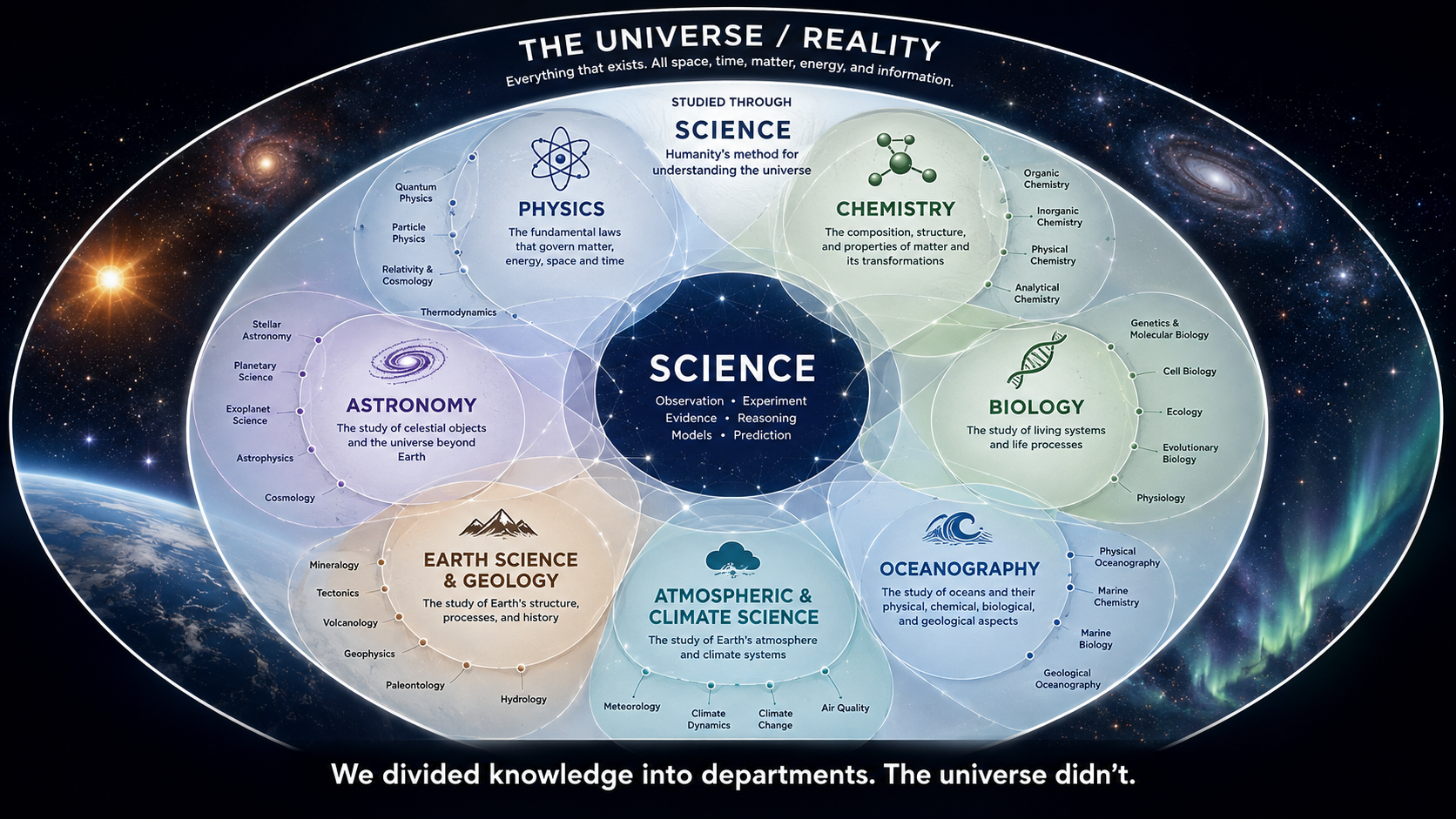
Science is just a big consistency test, applied to everything.
Over centuries, humans have discovered that nature behaves in consistent ways, regardless of humans knowing about it yet. Gravity existed before science existed, and gravity doesn't stop working when nobody is measuring it. We can describe and predict its effects with extraordinary precision, even though fundamental questions about the nature of gravity remain unanswered.
Carbon dioxide doesn't change its molecular properties depending on which political party controls Congress, though that would be interesting.
Water doesn't decide whether to expand when it freezes based on someone's opinion, thankfully, because that would be downright terrifying.
Photons don't check Facebook before interacting with matter, because that would just be ridiculous.
Those regularities are precisely what make science possible.
• We observe something.
• We propose an explanation.
• We measure it.
• We test it. Other people test it independently.
• We refine or reject explanations based on the evidence.
• Over time, broad explanatory frameworks can emerge that account for enormous bodies of evidence.
We develop mathematical descriptions of what is happening.
Then we use those descriptions to make predictions and compare those predictions with reality.
Sometimes we discover that we were wrong, or a model needs improvement, or new evidence changes our understanding dramatically.
That's not a failure of science.
That's how science works.
And gradually, after countless observations, experiments, failures, corrections and successful predictions, some things become extraordinarily well established.
That's how we know when an eclipse will occur in 2026 or in 2030. Or if you really like to plan ahead from 2081-2100.
Climate is harder than an eclipse.
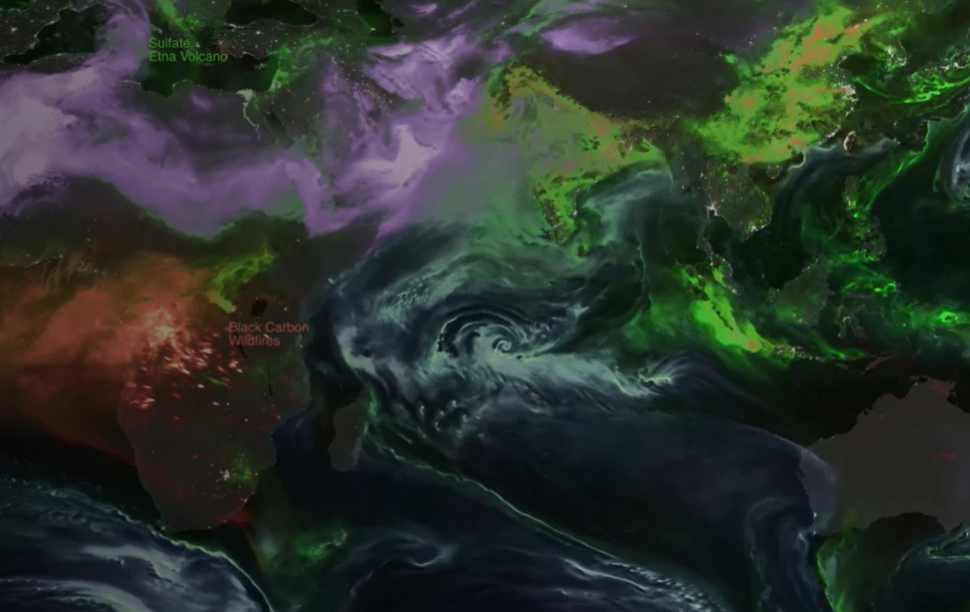
Earth’s atmosphere, image NASA
Predicting an eclipse is much easier than predicting Earth's climate.
The movements of the Earth, Moon and Sun involve a comparatively small number of well-understood variables.
Earth's climate system is enormously complicated.
Oceans circulate. Ice melts and forms. Clouds reflect sunlight. Plants absorb carbon. Volcanoes erupt. Aerosols move through the atmosphere. Ocean temperatures oscillate. Humans change landscapes and release greenhouse gases.
All of those systems interact.
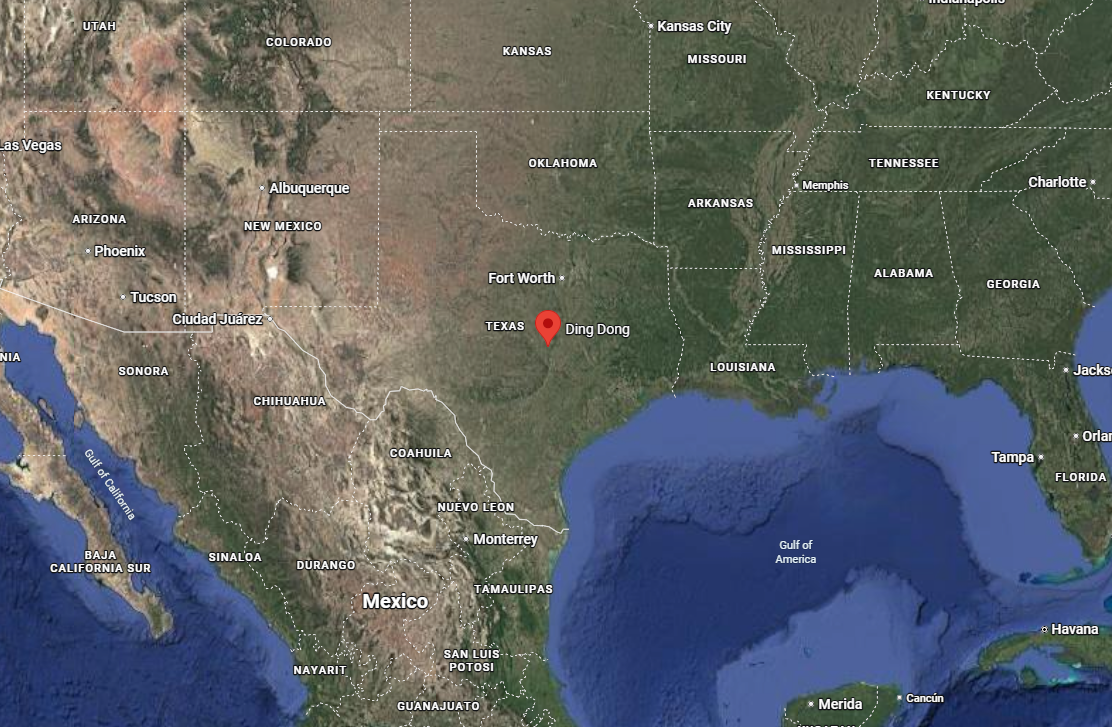
Ding Dong, Texas
So climate science contains degrees of uncertainty. But uncertainty about a complex system does not mean uncertainty about every physical process operating within that system or about how they interact.
We cannot say exactly what the temperature will be in Ding Dong, Texas, at 2:17 p.m. on August 12, 2056. But we can estimate how the climate of the region will change as greenhouse-gas concentrations increase.
How do we know?
We know because we can measure:
• the radiation those molecules absorb
• atmospheric carbon dioxide
• ocean temperatures
• sea level
• the energy entering and leaving the planet
• shrinking glaciers and ice sheets
• and scores of other metrics and impacts on human civilization
We can compare those observations with predictions made decades ago, and evidence within the Earth going back millions of years.
And all of those measurements have to make sense together.
Physics can't tell one story while chemistry tells another, satellites tell another, geology tells another, and ocean observations tell another. A successful scientific explanation has to account for the evidence across disciplines, funding sources, nations, and institutions.
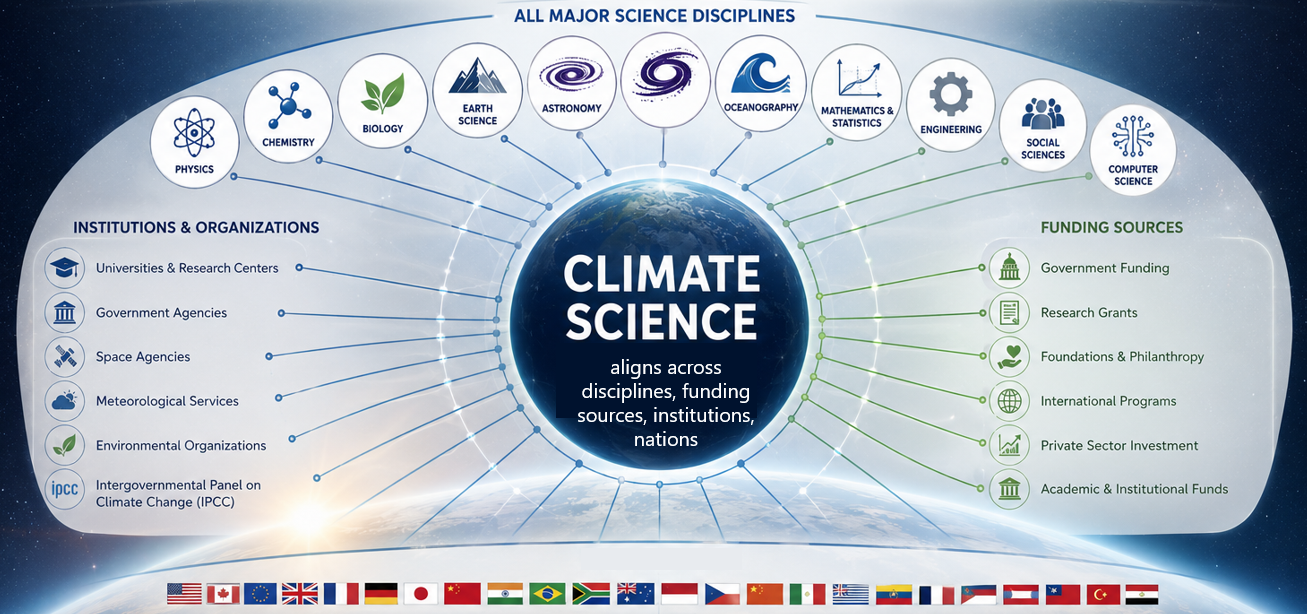
We can’t change just one piece of physics.
Suppose someone demonstrated tomorrow that increasing atmospheric CO₂ does not affect Earth's energy balance in the way physicists currently understand it.
That would be a big deal.
It wouldn't mean "Climate scientists were wrong."
Scientists would need to figure out why:
• laboratory spectroscopy was wrong
• satellite observations were wrong
• atmospheric measurements were wrong
• our understanding of molecular physics was wrong
• multiple independent lines of evidence appeared to agree when the underlying mechanism didn't exist.
Changing one well-established piece of science creates consequences elsewhere because our scientific understanding of nature is interconnected across disciplines, nations, funding sources, and ideologies.
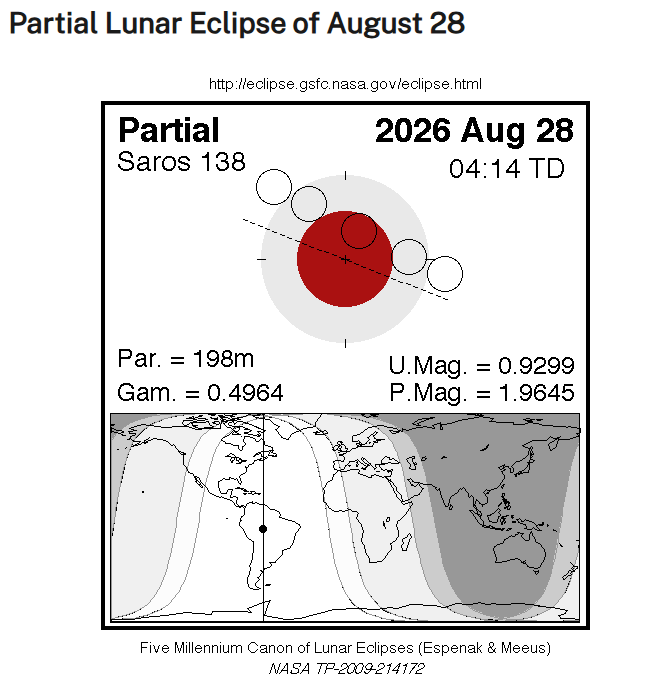
This NASA diagram shows the partial lunar eclipse of August 28, 2026, including the Moon’s path through Earth’s shadow and the eclipse’s predicted geometry and duration. The world map below shows where on Earth the eclipse will be visible, illustrating how precisely astronomers can calculate both the event and its geographic visibility in advance.
And that brings us back to the eclipse.
When scientists tell us where the Moon's shadow will cross Earth, most of us don't demand to see their equations, or build our own telescope, or reproduce centuries of celestial mechanics.
We recognize that thousands of specialists have spent generations developing and testing this knowledge, and then we go outside at the predicted time and watch the eclipse.
If the Moon appears exactly where they said it would, we're delighted.
But when another enormous community of scientists, using observation, physics, chemistry, geology, biology, satellites, ocean buoys, weather stations, ice cores, laboratory experiments and computer models tells us that increasing greenhouse gases are warming the planet, something strange happens.
Some people suddenly become extraordinarily concerned about scientific uncertainty.
Because perhaps the difference isn't “the science.”
Perhaps the difference is what accepting “the science” would require us to believe or do.
An eclipse doesn't
• threaten anyone's identity
• require legislation
• threaten an industry
• suggest that something we've been doing for generations has consequences
• imply that governments, businesses or individuals might need to change behavior
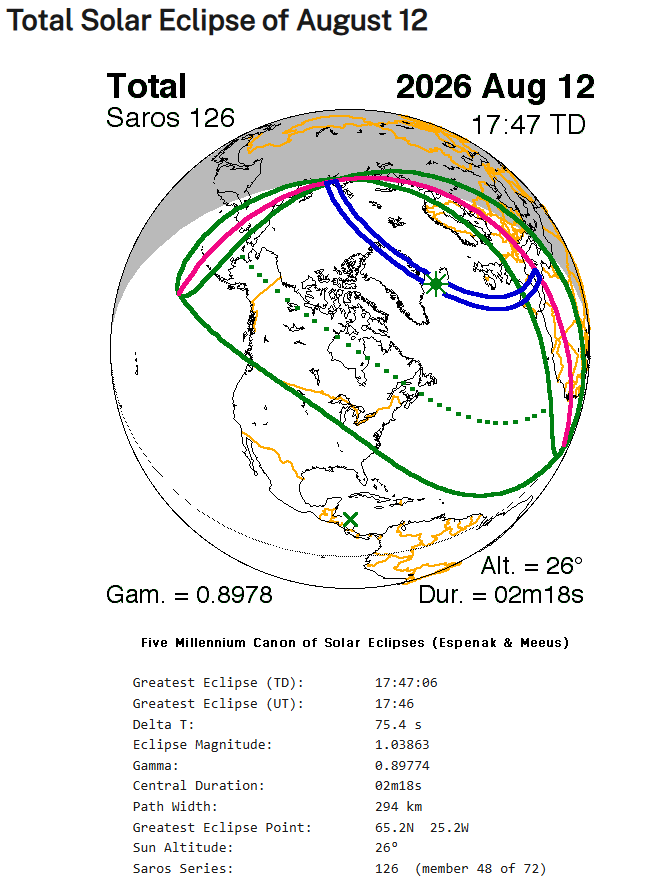
This NASA diagram maps the August 12, 2026 total solar eclipse, showing the Moon’s shadow path across the Arctic, Greenland, Iceland, and Spain, along with the regions experiencing a partial eclipse. It also shows the precision of the prediction: timing, path width, eclipse magnitude, Sun angle, and a maximum totality of about 2 minutes 18 seconds.
An eclipse just gives us something spectacular for everyday people to look at.
But watching an eclipse is watching the predictive power of science.
Not perfect knowledge, or unquestionable authority, or certainty about everything. Something better.
Human’s most effective tool to understand the universe and propel our advancement.
It’s all the same science. An eclipse results from the same rules of physics as a ball on a string, a flying plane, or just blocking a light with a piece of cardboard.
It’s the same science that tells us how the Earth, Venus, Titan, Saturn, Jupiter, or any planet we’ve yet to discover behaves and why.
The physics governing an eclipse doesn't disappear when we stop looking up and start examining the atmosphere around us. The chemistry doesn't change. The radiation doesn't change. The molecules don't change. The universe doesn't care whether its answers are fascinating, mundane, profitable, expensive, politically convenient or deeply inconvenient.
It's just there.
We decide whether we want to understand it or not.
We divided knowledge into departments. The universe didn't. It’s all the same stuff, and the same science to learn about it all.